


The Evolving Language of Landscape: Tradition, Atmosphere, and Abstraction
The Beaney House of Art & Knowledge, Canterbury
The Language of Landscape brings together four artists whose work spans a century of change in how landscape is seen, painted, and understood. From the classic English landscapes of Rowland Hilder, one of the most significant painters of the twentieth-century British countryside, and Gordon Rushmer, recipient of the Rowland Hilder Award, to the contemporary visions of Susan Mulley and Astrig Akseralian, the exhibition explores the evolving visual language through which artists interpret land, place, and environment.
The exhibition frames landscape not merely as scenery, but as a cultural and emotional construct shaped by memory, labour, imagination, and perception. Through the juxtaposition of realist and abstract approaches, the curators reveal how landscape painting has shifted from topographical documentation towards expressive, symbolic, and psychological interpretations of place.
Rowland Hilder: The Classical Language of the English Landscape
Rowland Hilder’s work represents the foundation of the exhibition’s historical narrative. Renowned for his winter landscapes and depictions of the English countryside, Hilder’s paintings embody a classical approach to landscape rooted in observation, harmony, and natural order. His compositions are structured, balanced, and restrained, emphasising quiet atmosphere, subtle tonal variation, and compositional clarity.
Hilder’s landscapes do not dramatise nature; instead, they present it as stable, enduring, and familiar. This calm realism reflects a traditional pastoral ideal in British art, where the countryside becomes a symbol of continuity and national identity. His work establishes a visual language of landscape as place—recognisable, rooted, and permanent—which forms an important contrast to the more fluid and interpretative approaches of the contemporary artists in the exhibition.
Gordon Rushmer: Atmosphere, Presence, and Lived Space
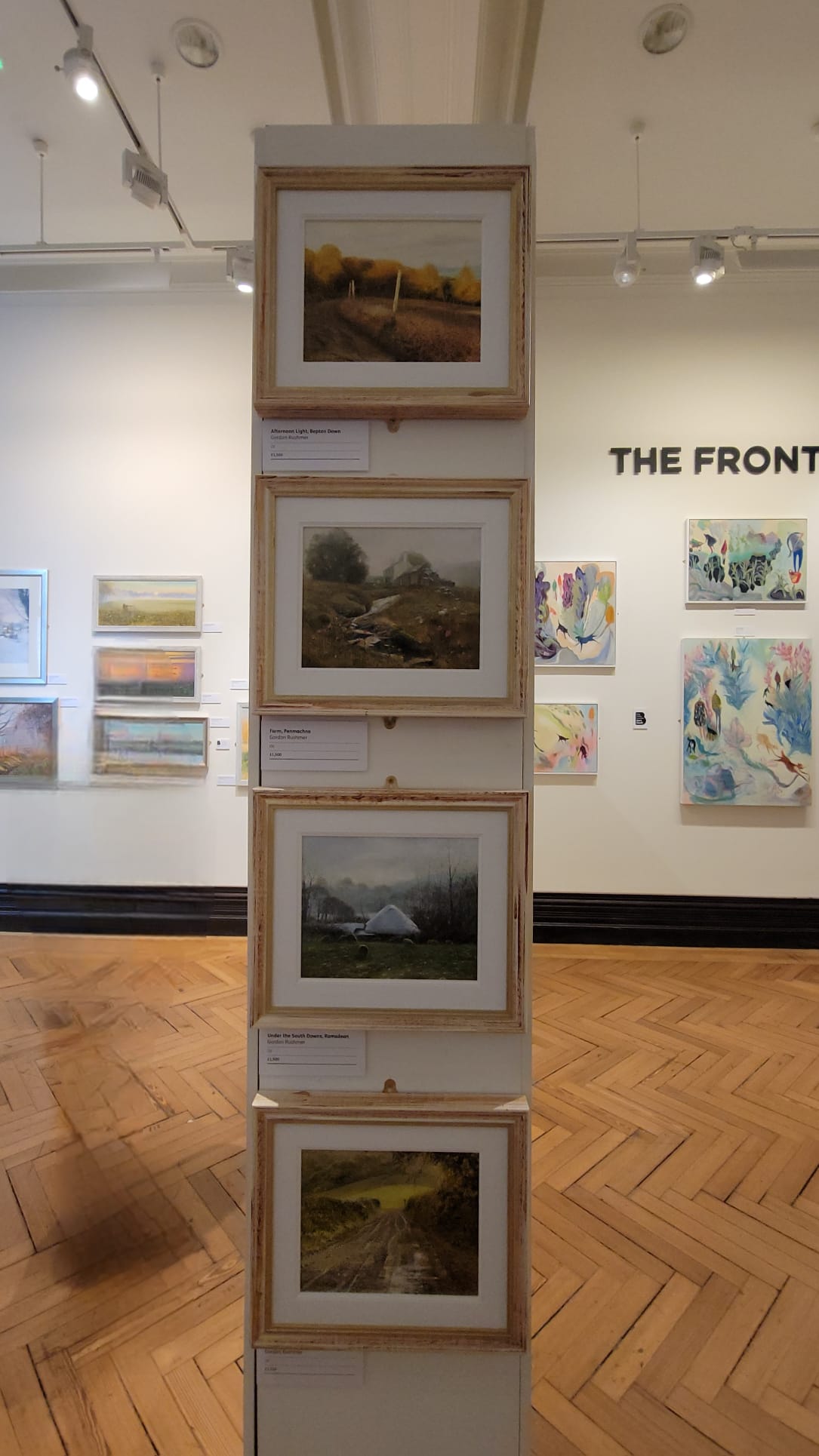
Gordon Rushmer’s paintings extend this realist tradition while transforming it into a more immersive and experiential form of landscape. Works such as Afternoon Light, Bepton Down, Farm, Penmachno, Checking the Flock, North Wales, and Along the Line of the Downs, Ditchling are characterised by subtle colour palettes, sensitive handling of light, and a strong sense of spatial depth.
Rushmer’s landscapes are not simply visual representations; they generate a sensory experience. His manipulation of perspective, atmosphere, and tonal layering creates the illusion of air, distance, and humidity, allowing the viewer to feel physically present within the scene. The muddy track, fading light, and receding horizons evoke familiar sensations of rural life—silence, isolation, dampness, and calm.
This immersive quality explains why Rushmer’s work invites deeper analysis. His paintings produce emotional recognition and spatial intimacy, creating a feeling of being inside the landscape rather than observing it from outside. From a critical perspective, his work operates within the British landscape tradition associated with artists such as Constable and Hilder, but with a contemporary awareness of land use, farming, and environmental change, making his landscapes both poetic and socially grounded.
Susan Mulley and Astrig Akseralian: Landscape as Imagination and Symbol
In contrast, Susan Mulley and Astrig Akseralian reinterpret landscape through abstraction, symbolism, and expressive colour. Their works dissolve traditional perspective and naturalistic form, replacing physical geography with fluid shapes, organic structures, and hybrid figures that suggest plants, animals, and dreamlike ecosystems.
Rather than describing specific places, their landscapes function as psychological and emotional spaces. Colour becomes symbolic rather than naturalistic, and form becomes expressive rather than descriptive. This approach reflects a contemporary understanding of landscape as subjective experience, shaped by memory, identity, and imagination rather than geography alone.
Conclusion
The Language of Landscape presents landscape painting as a dynamic and evolving genre. Through the works of Rowland Hilder, Gordon Rushmer, Susan Mulley, and Astrig Akseralian, the exhibition reveals how artists have developed different visual languages to represent land—from classical realism and pastoral stability to atmospheric immersion and abstract symbolism.
While Mulley and Akseralian expand landscape into imaginative and conceptual territory, and Hilder establishes its traditional foundations, Rushmer’s work stands out for its powerful sense of presence and atmosphere. His ability to translate land into lived experience creates emotional familiarity and spatial depth, making his paintings particularly compelling and worthy of focused analysis.
Exhibition represented by Francis Iles Gallery
Saturday 17 January 2026 to Sunday 15 March 2026 (Closed Mondays)
Front Room, Ground Floor, The Beaney