

When words fall away, the body begins to speak. I’ve always been drawn to the quiet power of subtle gestures—the tilt of a head, the turn of a shoulder, a gaze that never quite meets your own. These small movements carry immense weight. They reveal emotions that words often cannot capture: longing, uncertainty, intimacy, distance. In my practice, I try to listen to these silent languages and give them space to breathe on the canvas.
For me, gestures often say more than any narrative could. A glance can hint at connection, but also avoidance. A still posture may radiate calm, or conceal tension. Silence between figures becomes as meaningful as touch. I find myself returning to these understated expressions again and again, because they allow me to explore the complexity of human experience without overexplaining.
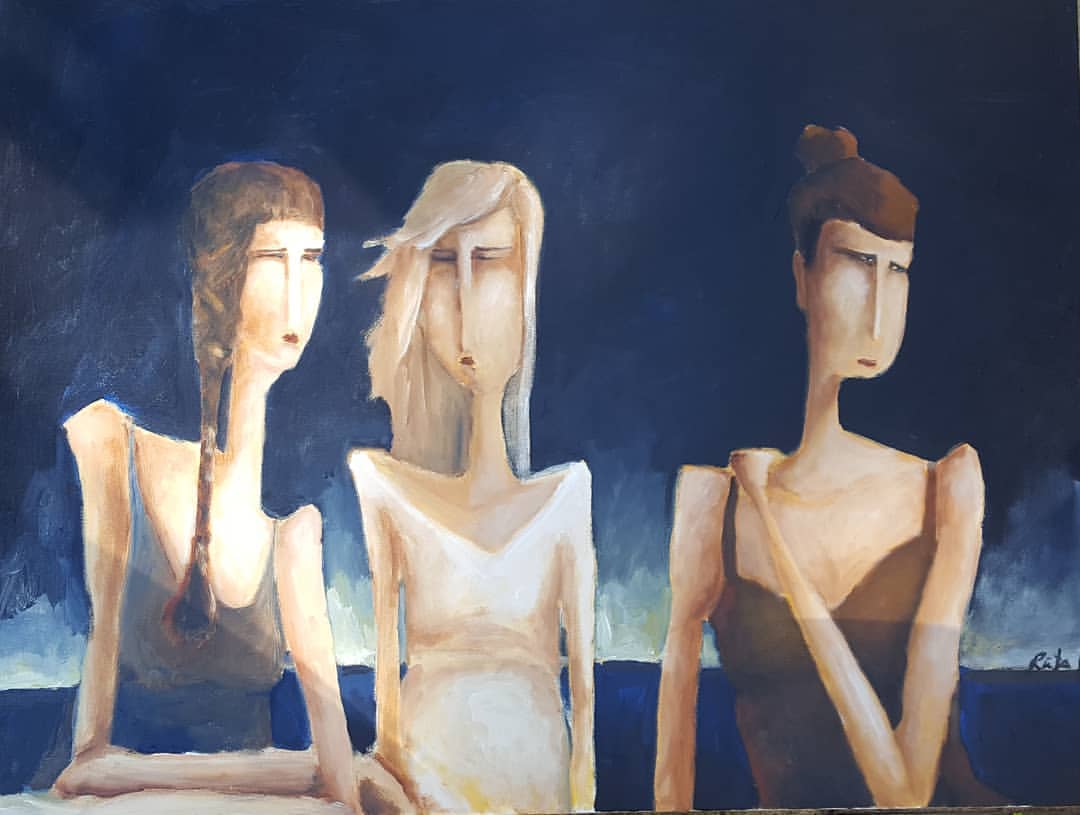
In Connections, for example, the figures stand close, yet their eyes drift in different directions. Their gestures create both separation and unity, suggesting the invisible threads that bind us together while acknowledging the spaces that remain between us. In Conversation II, the stillness of posture becomes its own kind of dialogue—a conversation made up not of words, but of presence. Even in my intimate portraits, a slight curve of the lips, the gentle slope of a neck, or the weight of lowered eyes can hold an entire story.
This fascination with gesture is part of a long tradition in figurative art. Egon Schiele captured raw honesty in the angular tension of hands and bodies, often conveying more through a single pose than through facial expression. Amedeo Modigliani softened his portraits into elongated calm, where the serenity of posture spoke louder than detail. Käthe Kollwitz, with her profound empathy, used the simplest of gestures to embody grief, resilience, and solidarity.
I think this is why I am drawn to gestures: they are timeless, universal, and endlessly interpretable. Unlike words, which can fix meaning too firmly, gestures allow room for ambiguity. They invite the viewer into the work, asking them to bring their own stories and experiences to what they see. A bowed head may speak of sorrow to one person, while another may see humility or contemplation.
When you stand before my paintings, I hope you read them the way you might read a person in conversation. Look at the posture, the silence, the space between figures. Notice where the gaze falls—or where it refuses to go. Ask yourself what is being withheld, and what is being revealed. These gestures are quiet, but they hold truths we all recognize.
For me, that is the language of figurative art: a language that does not shout, but whispers; one that does not explain, but suggests; one that leaves space for us to feel, to interpret, and to connect.